


Not long ago, outbound sales were considered a “numbers game”: hundreds of emails and messages were sent out in the hope that at least some would reach the right person. But today the rules have changed. Email filters have gotten stricter, customers more demanding, and old metrics like open rate have lost their meaning.
Companies that keep working from the old playbook get fewer and fewer replies and waste time. Those who implement AI outbound see the opposite effect: personalization becomes possible at scale, and the flow of demos turns into a systematic and predictable outcome.
Why has outbound “broken,” and how does AI fix it?
The problem with classic B2B outbound: cold emails, low response, spam filters
Over the past few years, outbound in B2B has gone from a working tool to an overloaded channel. Mass emails are increasingly seen as noise, and email service filters have become so strict that good offers simply don’t reach the recipient.
In 2024, Google and Yahoo simultaneously tightened the rules: the sender must authenticate the domain (SPF, DKIM, DMARC), add “one-click unsubscribe,” and keep user complaints below 0.3%. Violating even one of the conditions leads to blocking.
As Google noted:
We want people to be in control of their email and not waste time on spam.
On top of that, there’s the perception factor: executives receive dozens of emails every day, and templated offers go straight to the trash.
We want people to be in control of their email and not waste time on spam, Google explained when commenting on the updates.
Even a good offer doesn’t work if it looks like a mass email.
Data on the decline in effectiveness of email and LinkedIn outreach.
The market confirms: classic channels are getting less effective. And the issue isn’t just filters, but also that the metrics themselves are outdated.
- Open rate has become meaningless. Apple Mail Privacy Protection (MPP) masks real opens, inflating the numbers. Litmus states directly: “Open rate no longer reflects user interest”.
- Reply rate without personalization has collapsed. If you could count on 10–15% before, today the average is 3–5%.
- LinkedIn InMail works only in a “short + personal” format. LinkedIn research shows that short messages (<400 characters) get replies 2x more often.
| Channel | Before (2015–2018) | Now (2023–2025) |
| E-mail (open rate) | 20–30% | 70%+ (distorted by MPP) |
| E-mail (reply rate) | 10–15% | 3–5% without personalization |
| LinkedIn InMail | 15–20% | <10% general / >20% personalized |
“We’re seeing a sharp shift in metrics: opening an email means nothing; the key metric is a scheduled demo,” Forrester emphasizes.
Shift: customers expect personalization and value “from the first second.”
Today’s buyer expects the email to be written specifically for them. In a 2025 study, McKinsey notes: “71% of customers expect personalized interaction, and 76% get irritated when it’s not there.”
Today, an email should answer two questions in the very first line:
- why are you writing to me specifically?
- why does it matter right now?
The contrast is clear in this example:
- “We offer a tool to optimize hiring processes” — a generic statement you could address to anyone.
- “I noticed your company opened 15 new IT roles over the past 2 months — you may be looking to speed up candidate screening with video interviews” — a specific signal that shows attention to the real situation.
So outbound stopped being a “blast” and became a system of relevant touchpoints.
The arrival of AI: automated signal discovery, large-scale message customization.
Artificial intelligence can make outbound effective again by fixing its main problem — the inability to personalize messages at scale.
What AI does:
- Collects signals: analyzes news, job postings, interviews, data from the CRM.
- Creates hooks by role: the CFO gets an emphasis on efficiency, HR — on time-to-hire, the CTO — on integration risks.
- Scales personalization: hundreds of emails look unique, each with a specific reason to reach out.
- Adapts to the channel: for e-mail — longer messages with a CTA, for LinkedIn — short outreach messages.
- Optimizes for real KPIs: replies, clicks, demos scheduled.
Artificial intelligence moves outbound from the category of a “lottery” to the category of a managed system: the result becomes predictable rather than random, Gartner notes.
Process flow:
Data sources → Signal collection → AI text generation → Sending → Replies/demos.
Outbound isn’t dead, it has changed.
- Mass email blasts no longer work.
- Open-rate metrics have lost value.
- Customers expect personalization from the first second.
AI has become the key that makes it possible to scale personalization and turn outbound into a system of predictable demos. Now a steady flow of meetings isn’t luck, but the result of a properly configured process.
The principle of personalization at scale: how AI outbound works.
What “personalization at scale” means.
Traditional outbound has always faced a dilemma: either lots of contacts without deep work, or a small number of high-quality emails. Personalization at scale with AI removes this barrier.
The core idea: instead of one template for a thousand recipients, a thousand emails are created, each of which looks like it was written by hand. The foundation of this approach is signals:
- data from CRM and interaction history,
- social media activity (new posts, profile changes),
- mentions in news and press releases,
- headcount changes and new job openings,
- the recipient’s job context and area of responsibility.
Customers don’t expect mass attention; they expect relevance to their specific situation. – McKinsey emphasizes.
So, large-scale personalization = automated work with signals that’s impossible to do manually.
How AI turns “1,000 emails” into “1,000 unique messages”.
Previously, an SDR could personalize at most 10–15 emails per day. With AI, that number grows to hundreds and thousands without losing quality. The AI-outbound workflow:
The AI-outbound workflow:
- Signal collection. AI “scans” the CRM, LinkedIn, the company website, and media.
- Matching to the ICP. The system determines which events matter to the right persona (for example, a CFO responds to cost data, HR — to growth in openings).
- Hook generation. The first sentence of the email is created based on a specific fact.
- CTA formation. The call to action is tailored to the segment (“let’s discuss budget savings” ≠ “let’s look at how to speed up hiring”).
- Mass rendering. As output, the SDR gets 1,000 emails where each has its own first paragraph, tone, and argumentation.
AI makes it possible to combine scale and relevance. Where you used to choose between quantity and quality, now both are possible. – Gartner.
Use cases.
Generating subject lines and hooks:
A company’s CFO receives an email mentioning a recent report on declining industry margins.
An HRD receives an email noting that the company opened 20 new roles and will face added load on recruiters.
Dynamic context insertion:
“I saw the news about your expansion into Eastern Europe…”
“A quote from your CEO about digitizing HR processes got me thinking…”
Adapting tone to the segment:
C-level: concise, focused on strategy and money.
Middle management: more detail, emphasis on processes and benefits for the team.
Messages up to 400 characters perform better when they reflect the real context of the company or role. – notes LinkedIn Research.
Table: traditional vs. AI-outbound
| Parameter | Traditional outbound | AI-outbound |
| Scale | 1000 identical emails | 1000 personalized emails |
| Personalization | Name + title | Signals from CRM, news, social media, title |
| Tone | One for everyone | Adjusted to level (C-level ≠ management) |
| Result | 3–5% reply rate | 15–25% reply rate with relevant signals |
| Time to prepare | Hours/days of SDR time | Minutes with AI |
Scaled personalization is the key shift in outbound.
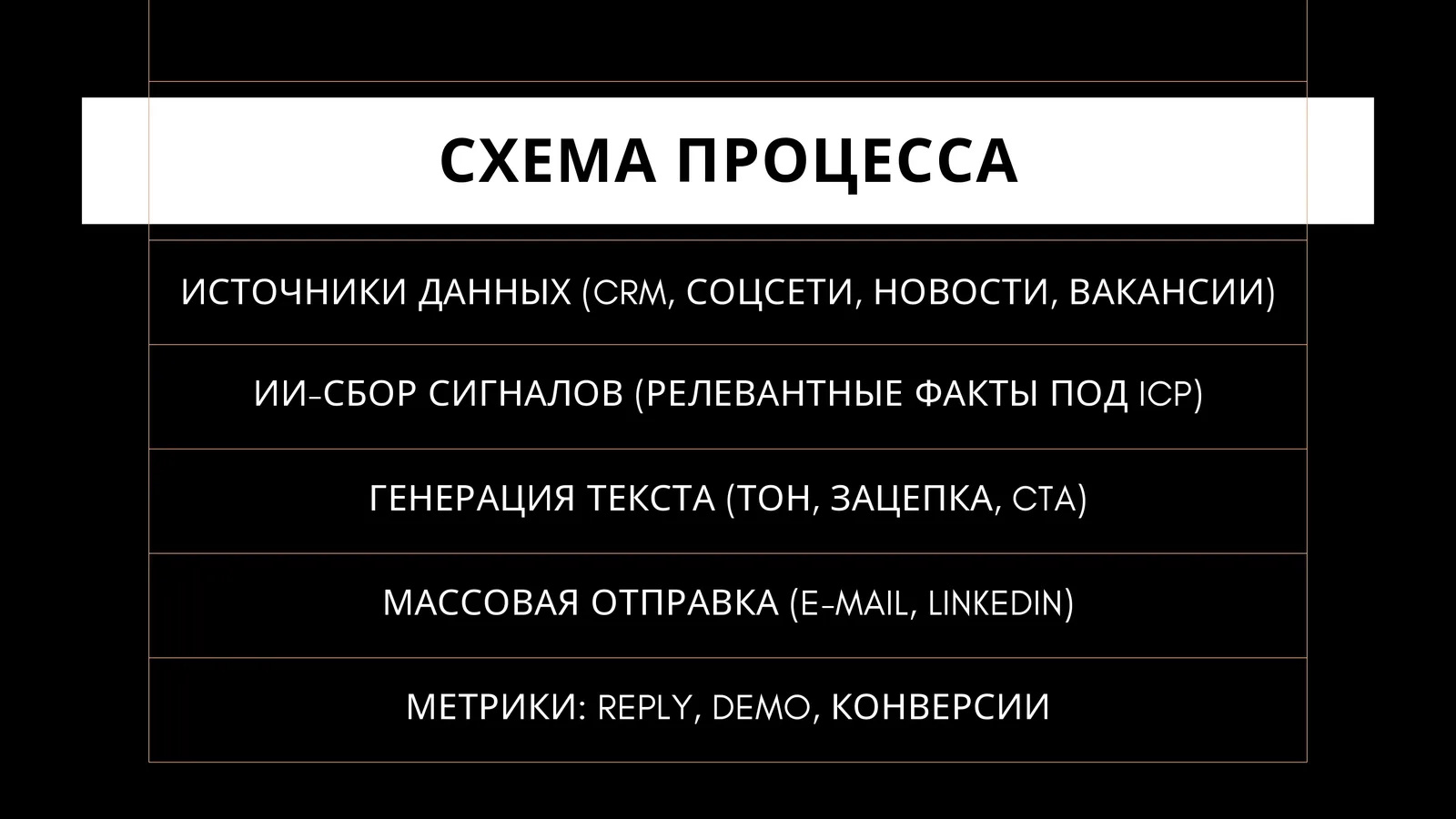
AI makes it possible to process thousands of accounts while still speaking to each recipient in their language. As a result, SDRs get not a stream of “noisy contacts,” but a manageable channel with a predictable number of demos.
Infrastructure: what you need to launch AI outbound.
Data sources.
Scaled personalization is impossible without the right data sources. They provide the raw material for generating “reasons to reach out.” The richer and cleaner this data is, the higher the chance the email will look appropriate and valuable.
For example, CRM shows the history of previous touchpoints: if a company was already interested in the product six months ago, AI can use that fact. LinkedIn provides fresh updates about a specific person’s role or promotion. Corporate sites and news portals reveal strategic initiatives: expansion into new markets, a product launch, a funding round. Even job pages become an important source — they signal team growth or a shift in priorities.
Main categories of sources:
- CRM and sales databases;
- LinkedIn and social media;
- corporate sites and press releases;
- company aggregators (Crunchbase, ZoomInfo);
- career pages and job postings.
The quality of personalization is determined less by the algorithm than by the data that feeds it. – McKinsey emphasizes.
Tools.
Once the data sources are defined, the question is: how to turn them into a stream of personalized touches. This is where the tool stack comes into play.
The AI module is responsible for processing and interpreting signals: it analyzes the text of news, job postings, and LinkedIn posts and turns them into hypotheses for hooks. The outreach platform manages sending and the sequence of touches, while the CRM stores feedback and records results.
But the main value appears only when all systems are connected via API. In that case, the SDR gets not raw data as the output, but ready-to-send copy that can be sent right away.
AI outbound infrastructure usually includes:
- AI module for generating emails,
- Outreach platform (Apollo, Outreach.io, Lemlist),
- CRM for storing history and statuses,
- API integrations between systems,
- Analytics dashboards (Looker, Power BI) for tracking KPI.
The winners aren’t the companies with the most advanced AI, but those that managed to build the right integration of data and processes. – Gartner notes.
Pipeline principle.
AI outbound infrastructure works like an assembly line. Each stage reinforces the next, and a failure in one place breaks the whole system.
First, data is collected from the CRM, social networks, websites, and job postings. Then the AI module analyzes it and forms relevant messages. What matters is that at the generation stage, the text isn’t sent right away — validation happens: the system checks uniqueness, wording accuracy, and tone. Only after that do the emails go to the outreach platform, which is responsible for sending via e-mail or LinkedIn. As the output, the SDR sees not a “mass mailing,” but a report on replies and scheduled demos.
The pipeline looks like this:
Signal collection → AI text generation → Validation and correction → Sending via the outreach platform → Reply/demo analytics.
Table: manual outbound vs. AI outbound
| Stage | Manual outbound | AI outbound |
| Data collection | SDR manually searches on LinkedIn and in the news | Automatic collection from CRM, social networks, websites |
| Copy preparation | 10–15 emails per day | 500–1000 unique emails |
| Verification | Limited, manual | Automated validation and A/B tests |
| Scale | Depends on the number of SDRs | Scales without increasing headcount |
AI outbound is not just email generation. It is an infrastructure where data, tools, and processes are built into a single system. Without CRM there will be no touch history, without LinkedIn and websites there will be no current signals, without an outreach platform there will be no speed, without analytics there will be no understanding of what works.
But if you connect all the elements into a pipeline, outbound stops being a chaotic blast and becomes a managed process, where every thousand emails turns into dozens of meaningful conversations and a steady flow of demos.
Success metrics: how to tell whether AI outbound works.
Key KPIs: from open rate to demos per 100 contacts.
Until recently, the performance of outbound campaigns was measured by two key metrics: open rate and click rate. But today they have almost lost their meaning. Apple Mail Privacy Protection (MPP) makes open rate inflated and unrepresentative: reports can show 80–90% “opens” that don’t actually reflect interest.
More stringent but honest metrics are replacing them. The main ones are:
- Reply rate — the percentage of replies, even if it’s “no” or “not interested.”
- Demo rate (booked demos per 100 contacts) — how many meetings you managed to book for every 100 touches.
- Conversion rate — the share of demos that moved into an opportunity in CRM.
Opening an email means nothing today. The real performance indicator is a dialog you can continue. – Forrester.
Only through the lens of replies and demos can you really judge whether AI outbound works.
Why a “no-interest reply” is still a signal.
At first glance, a negative reply seems like a failure. But in practice it’s an important indicator:
- “We’ve filled the role and aren’t looking for a solution right now” — means the company really was hiring, and the contact is relevant.
- “This isn’t my area of responsibility” — a reason to clarify who makes the decision.
- “We already use another solution” — a signal of a competitive environment.
- Each reply helps refine the ICP, adjust the database, and filter out non-target clients.
So even a rejection isn’t the end of the funnel, but part of the analytics.
AI analytics: forecasts and hypothesis testing.
AI is changing how outbound campaign analytics are done. Where teams used to rely on Excel spreadsheets and manual reports, today the system itself shows where the bottlenecks are and which hypotheses work.
Key uses of AI analytics:
- Lead forecast. An algorithm based on current reply/demos calculates how many meetings will be booked if you increase the list by 1000 contacts.
- A/B testing of subject lines and hooks. AI automatically selects wording, records results, and identifies patterns.
- Sequence optimization. The system sees that, for example, the third follow-up gets more replies than the second and rearranges the order.
Using generative AI makes it possible to shorten the hypothesis validation cycle from months to weeks. – McKinsey.
Mini case studies: how results change
In practice, implementing AI outbound can significantly increase conversion with the same list size.
- Tech company (B2B SaaS). With the same 5000 contacts, classic outbound delivered 15 booked demos. With the AI approach, it was 48. A 3.2x increase.
- Retail consulting. Previously, the reply rate was 4%. After implementing AI outbound, the metric grew to 18% — more than 4x.
- Fintech startup. In a small market (fewer than 1000 ICP contacts), AI made it possible to get the most out of the list: 1 demo per every 7 emails versus 1 per 30 previously.
A mini table for illustration:
| Metric | Classic outbound | AI outbound |
| Reply rate | 3–5% | 12–20% |
| Demos per 100 contacts | 2–4 | 8–12 |
| SDR prep time | hours/days | minutes |
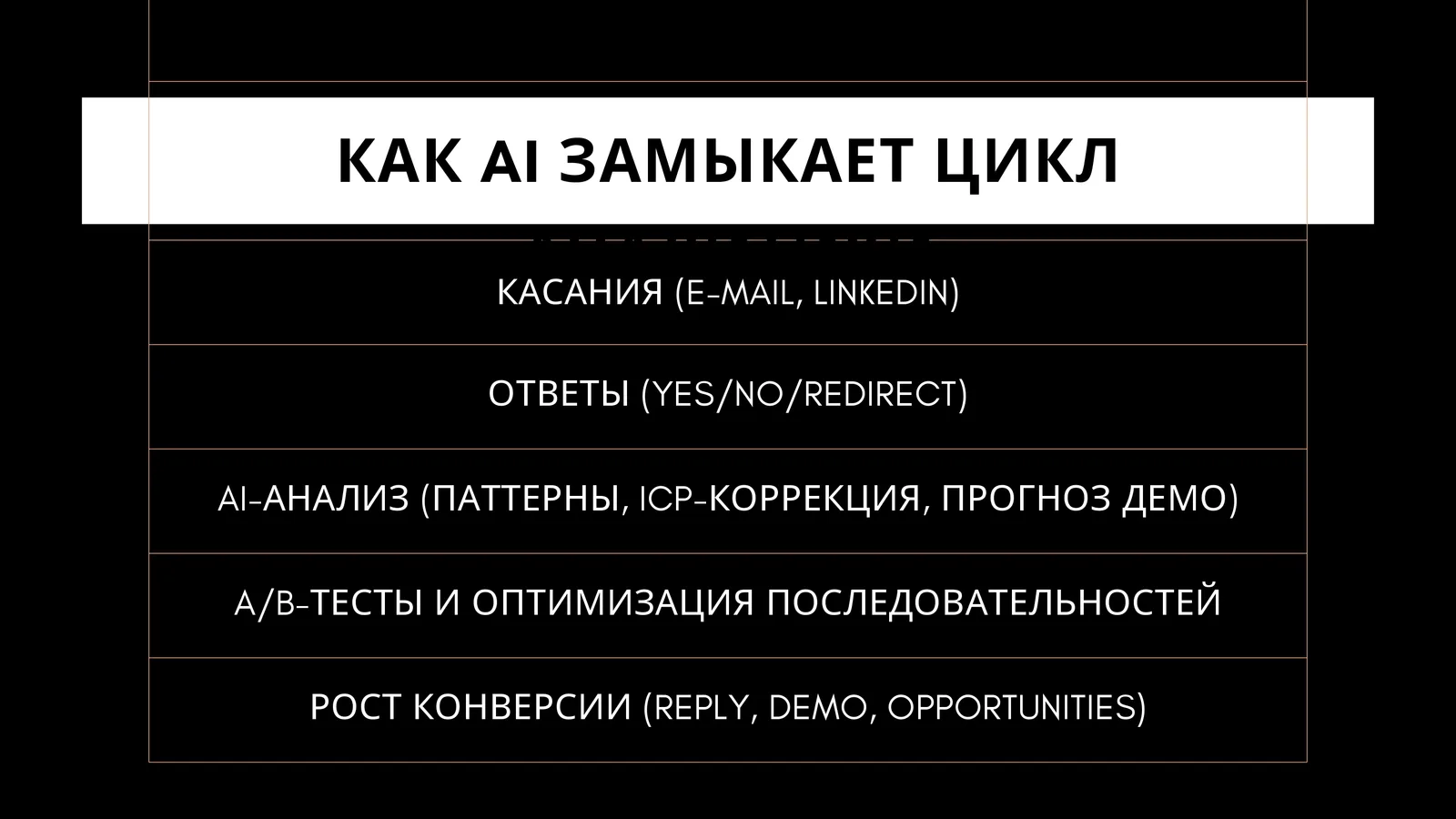
Outbound metrics have evolved: open rate stopped being important, and reply and demos per 100 contacts moved to the forefront. Even “no” is useful now: it’s a signal that helps refine the ICP and strengthen the database.
AI’s strong suit is analytics: it not only automates sending, but also turns it into a continuous learning system. Every reply, every hypothesis, every pattern goes into the knowledge base, and the campaign becomes more and more accurate.
AI makes outbound less a communication channel and more a hypothesis lab, where each iteration improves the result. – Gartner.
As a result, companies that implement AI outbound see a 3–5x increase in conversion without increasing the size of the list. That means success is now measured not by the number of emails, but by the quality of demos and the speed to a deal.
Use cases: consistent demos as a system.
Outbound models: from email-only to multichannel.
Outbound today is no longer the “default” channel. There are now several options, and the choice depends on the market, ICP, and goals.
- Email-only. A minimal model where all communication goes through email. Works for markets with strong email discipline (for example, IT and finance in the U.S. and Europe). The downside is heavy inbox competition and the risk of filtering.
- LinkedIn + email. A combined model: the first touch via LinkedIn (short and personal), then an email with a more detailed offer. According to LinkedIn, such sequences increase the chance of a reply by 35%.
- Multichannel outbound. Several channels are used at once: email, LinkedIn, calls, and sometimes WhatsApp or SMS. This strategy provides the most resilience and lets you “catch up” with a prospect if they didn’t respond in one channel.
Multichannel outbound works better because it spreads the risk: if one channel is overloaded, another can deliver results. – Gartner.
How AI supports “touch cadence.”
The key outbound problem is consistency. Many SDRs burn out on the second email, thinking, “If they didn’t reply, they’re not interested.” But the stats say otherwise: up to 60% of replies come on touches 3–4.
AI helps automate and maintain a touch cadence—a sequence of emails and messages over 10–14 days. It analyzes recipient behavior and adjusts the next step: if the email was opened but there’s no reply, it shifts to a different argument; if the contact clicked a link, the follow-up adds specifics.
A typical AI cadence:
- A short LinkedIn message (≤300 characters).
- The first email with a signal from the news.
- A follow-up after 3 days—mentioning a different benefit.
- A LinkedIn InMail with an additional insight.
- A final email with a specific CTA (“let’s schedule a 15-minute demo”).
Personalized follow-ups: “no reply means you missed a detail.”
If a prospect didn’t respond, it’s not always a “no.” Most often it means the first message was too generic or didn’t hit a current pain point.
AI helps here with dynamic follow-ups:
- If you mentioned a new geography, in the second email you can reference the team that works there.
- If it was about reducing costs, the follow-up can emphasize implementation speed and payback.
- If the recipient clicked through to the website but didn’t reply, AI will insert an argument tied to that section (for example, “you were looking at case studies”).
People reply more often when the follow-up contains new information rather than repeating old information. – LinkedIn Research.
How a pipeline of regular demos is built.
The main outcome of AI outbound is turning a chaotic channel into a system of consistent meetings. If demos used to be a “lottery,” now their volume can be forecast.
- One SDR in classic outbound schedules 2–4 demos per week.
- With an AI pipeline and a multichannel cadence, that number grows to 1–2 demos per day.
- What matters is that the workload doesn’t increase: AI works alongside the SDR, processing hundreds of signals and generating copy.
| Metric | Classic outbound | AI outbound |
| Demos per week | 2–4 | 5–10 |
| Demos per day | 0,5–1 | 1–2 |
| SDR prep time | Hours | Minutes |
AI turns demos from occasional wins into a stream of meetings you can plan and scale. – McKinsey.
Outbound is no longer a set of disconnected emails. Now it’s a system, where AI manages data, signals, and sequences.
- Models can vary: from email-only to multichannel.
- Follow-ups no longer repeat the same thing and instead add new arguments.
- Sequences are built not by intuition but based on data.
And most importantly, the result becomes predictable. The demo flow turns into a daily KPI the company can plan and scale along with team growth.
Where B2B outbound with AI is headed.
A shift from “mass emailing” to “mass relevance.”
Classic outbound was built on the principle: “the more emails, the higher the chance of a response.” Today that logic is broken. Mass emailing is seen as spam, and its effectiveness is wiped out by filters and low trust.
With the emergence of AI, a qualitative shift is happening: it’s now possible to combine scale with relevance. What an SDR used to do manually in 10 emails, the system does in 1000 touches automatically, while keeping the feel of a “personal conversation.”
Companies implementing generative AI in outbound see a 3–5x improvement in conversion without growing their database. – McKinsey.
AI as a competitive advantage.
AI stops being a “toy” and becomes a strategic asset. Its value shows up in two things:
- Testing speed. The algorithm can validate dozens of hypotheses on topics and message formats in a matter of weeks, whereas it used to take months.
- Accuracy. The system tailors the message to the industry, role, and current events, increasing the likelihood of a response several times over.