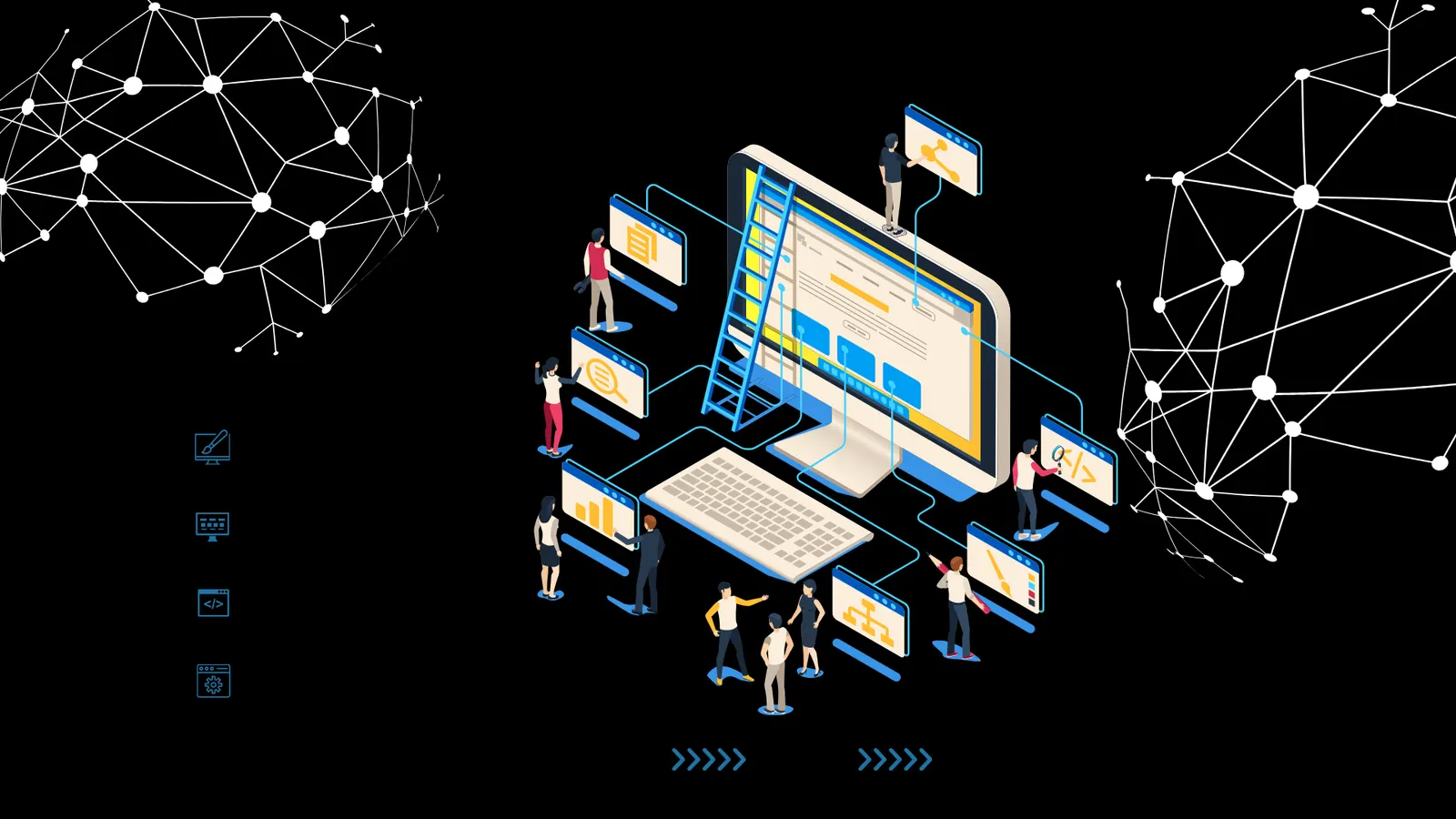




Headless architecture stopped being an “enterprise toy” a long time ago and is showing up more and more often in small-business projects: you need a fast website, a flexible storefront, “no-drama” integrations — while the budget and team are limited. Separating the storefront (frontend) from the “body” (content, catalog, payments, logic) promises freedom: you change one part without breaking the other, connect any services, and grow across channels — from a website to an app and marketplaces. But that freedom almost always hides new complexity: more integrations, higher demands for discipline and support, and you have to calculate TCO more carefully.
Architecture is about the important things that are hard to change, — Martin Fowler.
This idea is especially true for small businesses: a mistake in choosing an architecture doesn’t cost you at the start, but six months later, when campaigns, localization, and seasonal peaks kick in. We see the same scenario: headless works great where marketing needs to move faster than development, and the product needs to plug in new channels and experiments quickly. And, on the contrary, it makes life harder if the business is fine with a standard site builder and releases once a quarter.
In this article, we’ll break down in plain language what headless is, where it really brings money and speed, and where it adds an extra layer of complexity; how to evaluate risks and metrics, and at what points the decision is worth revisiting. The goal is not to “sell the technology,” but to help you make a grounded decision for your reality.
What headless is and why small businesses use it
The headless approach often sounds like a “magic” solution: separate the storefront from the core, connect any services, and move faster than competitors. But the point isn’t a trendy acronym; it’s an architectural principle of separation of responsibilities. For small businesses, this is especially important: marketing wants to launch campaigns here and now, the product doesn’t want to depend on CMS legacy, and the owner wants to see ROI without support costs exploding. Headless promises everything at once — frontend flexibility, freedom to choose backend services, and scalability for future channels (an app, marketplaces, in-store screens). The only question is how much that freedom costs and where it actually pays off.
Architecture is about important decisions that are hard to change, — Martin Fowler.
We are stubborn on vision and flexible on details, — Jeff Bezos.
These two quotes describe headless well. The vision is not to tie the project’s future to a single platform; the details are which modules and services to choose today so you don’t regret it tomorrow.
Simple explanation: the “head” (storefront) separate from the “body” (data and logic)
In a monolithic website, the “head” and “body” are fused: rendering templates, content, catalog, cart, payments — everything lives in one system. Headless separates the layers:
- “Head” — any storefront (a Next/Nuxt website, a mobile app, an in-store screen) that pulls data via API.
- “Body” — a set of services: a headless CMS for content, catalog/cart/orders, payments, search, personalization, analytics. They communicate with each other and with the storefront via REST/GraphQL/webhooks.
The upside of this separation is obvious: you can change the storefront without rewriting the core, and vice versa—add a new payment provider or search without touching the frontend. For small businesses, this means marketing can launch a promo landing page in days without waiting for a major release, and the owner doesn’t get “married” to a single boxed solution forever.
Good architecture gives you the freedom to evolve the system, — Roy Fielding.
What we compare: website builders, classic CMSs, and monoliths
To understand the “why,” let’s compare it with what small businesses use most often.
- Website builders (Tilda/Wix/Shopify themes). Fast to start and a low barrier to entry. But as soon as you need non-standard integrations, multilingual/multi-storefront setups, or high performance, the limitations show up.
- Classic CMSs (WordPress/1C-Bitrix, etc.). A huge plugin ecosystem, but the frontend is tightly coupled to the core. Any serious customization turns into “jumping through hoops.”
- Monolithic e-commerce (an “all-in-one” box). Convenient as long as you live by the box’s rules. Hard when you need something “not like everyone else”: new channels, unusual cart logic, or personalization.
- Headless. Flexible, but requires discipline: strategic service selection, observability, SLAs, and ownership of the “glue.”
A small reference table (to highlight the contrast):
| Approach | When it fits | Pros | Cons |
|---|---|---|---|
| Website builder | Landing page, simple catalog, quick test | Speed, low cost | Customization ceiling, weak scalability |
| Classic CMS | Content site with moderate customizations | Ecosystem, familiar flows | Tight coupling of frontend and core, tech debt |
| Monolithic e-com | “Out of the box,” without anything exotic | Coherence, one vendor | Rigid, expensive changes |
| Headless | Channel growth, special integrations, performance | Freedom, storefront speed | Integration complexity, TCO, expertise |
Speed without architecture is a sprint into a wall, — Kent Beck.
What a headless stack consists of: frontend, content CMS, catalog/cart, payments, API
Frontend. Most often these are Next.js/Nuxt/Remix/astro approaches with SSR/SSG/ISR for Core Web Vitals. This is where the design system, routes, page rendering, and analytics integrations live. In small business, the frontend is what delivers “perceived speed” and conversion.
Headless CMS. A content repository and media library. The main advantage is the role model and workflow (editor/layout designer/review), localization, and previews for marketing. Content goes via API to the storefront and other channels — Telegram bots, apps, email campaigns.
Catalog/cart/orders. Either as a ready-made service (headless commerce) or as your own module. It’s critical to think through identifiers, product variations, taxes/shipping, promo rules, and webhooks in advance.
Payments. Connecting multiple providers (for example, a local PSP + PayPal/Stripe/CloudPayments). Headless makes payment routing and fault tolerance easier.
Search/personalization. An external service (like headless search) or your own index. Speed, relevance, and query analytics matter here (a source of insights for content and assortment).
API layer. Stitching REST/GraphQL together, authorization, caching, retries, webhooks. For small businesses, it’s critical to have a single place to define contracts (schema/spec) and monitoring — otherwise any “small” integration becomes a blocker.
Everything breaks all the time. What matters is how quickly you recover, — Werner Vogels (Amazon CTO).
In practice, when we assemble a headless stack for a client, the most common starting point looks like this: a storefront on Next.js, a headless CMS for content, off-the-shelf headless commerce (or an orders module), two payment providers, cloud search, and a thin BFF layer (backend-for-frontend) with caching and logging. This provides a balance between launch speed and future flexibility.
Common myths: “faster, cheaper, without developers” — what’s true vs. what’s wishful thinking
Myth 1: headless is always faster.
The frontend really can be deployed quickly — especially if you already have a design system. But speed comes from processes: CI/CD, previews for editors, canary releases, a knowledge base for content. Without that, a “fast frontend” turns into running in circles.
Myth 2: headless is cheaper.
At the start — not always. You pay TCO: storefront development, CMS/search licenses, cloud, monitoring, support. Savings show up later, when the freedom lets you ship campaigns, multiple languages, new channels faster — without a “major overhaul of the boxed solution.”
Myth 3: headless eliminates developers.
On the contrary, it changes the profile: fewer “dances” around CMS limitations, more work with contracts, cache, security, and DX (developer experience). Marketing gains autonomy over content, but integrations and reliability still require engineers.
Myth 4: headless will solve SEO problems “by itself.”
The upside is control over performance and data structure. But SEO/AEO rest on content strategy and markup. Fast SSR is the foundation, and visibility growth is the result of the editorial team’s and analytics work.
Premature optimization is the root of many problems. Optimize what repeats often and impacts the customer. — Donald Knuth.
What’s true? With headless, the business really gets speed of change (content, campaigns, A/B tests), omnichannel delivery (one data set — many storefronts), and performance (Core Web Vitals → conversion). The cost is integration complexity, contract discipline, support processes, and real TCO. For small companies, this pays off when: (a) marketing is moving faster than development; (b) you need multiple channels/localizations; (c) you require high performance and flexible personalization.
Headless is neither a cure-all nor “complexity for fashion’s sake.” It’s a tool that makes a business less dependent on a single platform and more ready to scale. If you have a simple website without many integrations, a website builder or a classic CMS may be more reasonable. But if you’re looking at multichannel, regular campaigns, fast changes, and strict performance requirements, headless provides the freedom worth paying for. In the next sections, we’ll break this down with numbers, risks, and criteria for “when yes/when no.”
Where headless brings freedom and revenue
The main reason small businesses look toward headless isn’t “pretty technology,” but the ability to respond to the market faster and monetize attention. By separating the storefront from the core, a company gets the right to change the frontend and content independently of the catalog, cart, and payments. In day-to-day work, this turns into simple but revenue-driving effects: marketing launches campaigns without a backend redeploy, the editorial team publishes localizations in a day, A/B tests run as a continuous process, not as a “quarter-long project.” Yes, you pay for freedom with discipline—API contracts, observability, and support. But where change speed and multichannel truly matter, the cost pays off.
Speed of change is a competitive advantage if you’ve learned to sustain it, — Jason Fried, Basecamp.
Content and marketing speed: campaigns, localization, A/B tests without delays
In a classic monolith, the editorial cycle is often tied to releases: to publish a new promo landing page, you have to touch templates and wait for developers. In headless, content lives in a CMS with workflows and permissions, and the storefront simply subscribes to the API. Marketing gets editorial autonomy: assembling pages from modules, launching seasonal banners, rolling out new messages “today for today.”
This is especially noticeable with localization. In headless, copy, media, currencies, and date formats are data, not elements “hardcoded” into templates. You add an Italian version not by rewriting the frontend, but by translating the content and connecting the right pricing rules. For small businesses, that’s dozens of hours saved and no release “freezes.”
A/B tests change in nature too: instead of rare experiments “for big occasions,” you ship iterative, small tests—change a headline, the order of blocks, a recommendation widget. A Next/Nuxt storefront lets you safely roll out variations to audiences, while the CMS keeps versions. You’re not asking engineering for a “window”—you’re working in a flow.
A small illustration of the effects (typical ranges, not “magic promises”):
| What changes | Before headless | With headless |
|---|---|---|
| Launching a promo landing page | 3–10 days, tied to a release | 0,5–2 days, editorial cycle |
| Localizing a promotion | One to two weeks, template changes | 1–3 days, translating content in the CMS |
| Launching an A/B test | Once a month, as a project | Continuously, via modules |
Marketing wins not with ideas, but with the speed of the “hypothesis → experiment → conclusion” loop, — Rand Fishkin, SparkToro.
Multichannel done right: website, app, marketplaces, offline screens
Headless is designed as a single source of truth for data that different “heads” connect to. This means the product page, content, and promo rules are created in one place and shown wherever the audience is: a web storefront, a mobile app, a marketplace, a terminal at the counter, even a chatbot.
For small businesses, this is primarily about control and consistency. You don’t manually duplicate product descriptions and prices across three platforms; you publish and unpublish them centrally. You run a campaign—and it shows up on the site, in the app, and in email at the same time. If tomorrow you’re testing an offline point of sale, the same CMS serves the promo to the screen at the register.
The second layer is channel specifics. The web needs speed and SEO/AEO, the app needs push notifications and offline cache, the marketplace needs inventory and price synchronization. Headless lets you build thin adapters for each channel without breaking the core. And the best part: adding a new channel is an integration project, not a project to “move the entire site to a different system.”
Omnichannel is about unified data and different interfaces. Swap the word order and you’ll drown—an internal rule of product teams.
Performance and visibility: Core Web Vitals, SEO, and AEO (getting into AI answers)
Conversion is sensitive to speed. By separating the storefront and the data, you can build the frontend for the metrics rather than “whatever comes out of the box”: server-side rendering (SSR) for critical pages, static generation (SSG/ISR) for the catalog, caching at the BFF level, image optimization, preloading critical resources. This is a direct path to green Core Web Vitals—LCP, CLS, INP—and, as a result, to higher conversion and better traffic quality.
Visibility today is not only classic SEO, but also AEO (Answer Engine Optimization): getting into AI answers (Google AI Overviews, Copilot, Perplexity). Headless helps here technically: you control the HTML structure, structured data (FAQ, HowTo, Product), a clean heading architecture, and data delivery for snippets. But the main thing is editorial discipline: clear answer fragments, comparison tables, FAQ blocks that systems readily quote.
It’s important not to confuse roles: headless provides the foundation (performance, structure), while visibility growth is driven by the content and the product. When editorial, marketing, and development work as a single chain, speed and visibility reinforce each other: you publish useful materials faster—and more often become a source for search and AI answers.
User experience starts before the click—with speed and a predictable interface,—Steve Souders (ex-Google Performance).
When it pays off in practice: typical small-business scenarios (cases and numbers)
Headless rarely “pays off on paper” in the first month. Its impact is in shorter cycles and lower transaction costs for each new campaign, localization, and channel. Here are typical scenarios from small and mid-sized business practice (generalized, without “fairy-tale” percentages):
Seasonal retail (e-commerce up to 10k SKU).
Task: quickly launch seasonal collections and promos in 2–3 languages, plus connect a marketplace.
What we did: a Next.js storefront, a headless CMS for content/translations, a headless catalog, two payment providers, a marketplace feed.
Impact in 3–6 months: time to launch promotions dropped from 7–10 to 1–3 days; pricing/locale errors almost disappeared; organic conversion increased thanks to storefront speed and structured content.
Conclusion: payback didn’t come in “one big push,” but as the sum of small accelerations that became the norm.
Service businesses (requests and bookings).
Goal: omnichannel leads (website + app + offline screens), booking flows, personalized offers.
What we did: headless CMS + BFF, booking module, storefront personalization by segment, CRM integration.
Impact: marketing launches “same-day” promos, A/B tests for forms run continuously; the average time from idea to campaign is 2–5 days instead of 2–3 weeks.
Takeaway: the speed gain in campaigns mattered more than any “feature” that used to take a month to build.
B2B catalogs and price-list storefronts.
Goal: complex pricing rules, multi-currency support, price lists for different segments.
What we did: headless CMS + headless pricing, SSR for product pages, feed exports, partner portal.
Impact: consistent terms across channels, fewer “manual edits,” visibility in search and AI blocks thanks to structured solution pages.
Takeaway: keeping data under control in one place turned out to be the main source of savings.
Headless ROI isn’t a single-line number; it’s the sum of smaller savings on every change — a practical implementation principle.
In short, headless pays off where there are lots of changes (content, promos, localization), multiple channels (not just the web), and speed requirements (both load time and the team’s response time). If you ship rarely and operate in one market, headless freedom may still cost more than it saves.
Headless freedom isn’t abstract; it’s specific levers: a fast editorial cycle and A/B testing, unified data across all channels, performance for conversion and visibility. The money shows up where those levers are used with discipline: content processes are formalized, API contracts are stabilized, observability is enabled.
Where headless adds complexity and what it costs
Headless sounds like freedom — and it is. But freedom in technology is almost always paid for with coordination complexity: more integration surfaces, higher requirements for discipline, observability, and accountability for the “seams.” For small businesses, this is especially noticeable: each new service is not only a license, but also a new point of failure, a new process, and a new role. So before “going headless,” it’s worth honestly calculating total cost of ownership, understanding who you’ll need to hire, what operational risks you’ll take on, and in which scenarios it’s simpler and more reliable to stay on a monolith or a site builder.
Complexity is what we pay for flexibility — Don Reinertsen, author of Principles of Product Development Flow.
Total cost of ownership (TCO): development, licenses, cloud, support
In the classic definition, TCO is not just “how much it costs to build,” but also “how much it costs to live with this every month.” For headless, TCO usually consists of five buckets:
- Development and implementation. Design system, storefront (Next/Nuxt/Remix), headless CMS setup, catalog/cart/orders integration, payments, search, BFF layer, baseline analytics, content migration.
- Licenses and SaaS. CMS, search, e-commerce core, email/push, antifraud, CDP/personalization (if you use it).
- Cloud and traffic. Hosting, CDN, databases, logs/traces, event queues, backups.
- Support and ongoing development. Retainer for bug fixes, minor releases, incident SLAs, on-call rotations.
- Risk buffer. Unplanned hours for third-party outages, API changes, legal requirements.
A short “checklist” (so you don’t forget the hidden line items):
| TCO article | People often forget about… |
|---|---|
| Storefront | Visual regressions, performance budgets |
| CMS | Workflow, previews, permissions, schema migrations |
| Payments | Refunds, retries, reconciliation, 3-D Secure |
| Search | Ranking tuning, synonyms, media indexing |
| BFF/API | Cache invalidation, contract tests, rate limits |
| Clouds/logging | Log/trace storage, alerts, aggregation cost |
Nothing is free: if you don’t pay with money, you pay with complexity, — Werner Vogels, CTO Amazon.
Experience with headless starts paying off when the speed of changes (campaigns, localization, A/B tests) and the number of channels make the time savings recurring. If you have one language, infrequent releases, and a simple catalog, headless TCO in the first year is often higher than a monolith/builder.
Team and skills: who to hire/train, how not to drown in the stack
Headless changes not only the stack, but also the organization of work. You’ll need skills that might not have existed in an “out-of-the-box” scenario.
- Frontend engineer(s) with SSR/SSG experience and performance optimization (Core Web Vitals, build isolation, accessibility).
- Integration engineer / backend-for-frontend. Contracts, caching, retries, queues, webhook debouncing.
- Content ops / editorial team. Workflows, previews, glossaries, localization, content version control.
- Light SRE / DevOps. Logs, tracing, alerts, RTO/RPO, secrets, IaC. In small business, this role can be partially covered by a partner.
- Security responsibilities. OAuth/Scopes, PII encryption, PCI-DSS for payments, DPIA/GDPR (if required).
The key to “not drowning” is minimalism and owning the seams:
- a limited set of services (each new one with clear value),
- a single BFF layer as the entry point for storefronts,
- contract tests between services,
- documentation and runbooks (how we put out the fire at night).
Adding people to a late project makes it later, — Fred Brooks, The Mythical Man-Month.
Operational risks: integrations, security, service “spaghetti,” vendor lock-in
Integrations. The more services, the higher the chance of a “domino effect.” What helps here: event queues (idempotency), retries with backoff, clear SLAs, and integration “health” dashboards (ideally, one screen for the whole system).
Security and data. Headless means more API keys, webhooks, tokens. Manage secrets centrally, minimize privileges, log access, and review regularly. For payments — PCI DSS, for personal data — GDPR/local laws, for cookies/trackers — consent and a fair policy.
“Spaghetti” of services. The headless antipattern is when every microservice pulls its own integration “directly.” A year later you get a diagram that’s scary to touch. The cure is a BFF/API gateway and agreed event-driven exchange. “All requests go through us” sounds boring, but it saves months.
Vendor lock-in. Ironically, headless can increase dependency—not on a monolith, but on SaaS modules (CMS, search, commerce). Strategy:
- choose SaaS with data export and a public schema,
- abstract the SDK (a thin adapter layer),
- avoid “deep” proprietary scenarios that are hard to reproduce later.
Architectural freedom is the right to reversibility of decisions, — Martin Fowler.
When it’s better to stick with a monolith or a website builder: “not our time yet” criteria
Headless doesn’t have to be the default answer. Here are honest signs the time hasn’t come yet:
- One channel and one market. You have a single-language site, no apps or marketplaces; updates once a month—a website builder/classic CMS will solve it faster and cheaper.
- Infrequent campaigns. Marketing doesn’t run in iterations; A/B tests are occasional; there’s no content-ops team—the headless direction will stall.
- Small catalog and simple logic. Up to hundreds of SKUs, no custom cart, shipping, and tax rules.
- Limited budget/staff. No resources to maintain integrations, monitoring, and on-call rotations—better not multiply entities.
A small “sanity matrix”:
| Criterion | If this is the case—it’s still too early for headless |
|---|---|
| Channels | Only a website, no app/marketplaces |
| Geography/languages | One language/country |
| Change frequency | Releases every 2–4 weeks |
| Catalog/rules | Simple catalog, no special scenarios |
| Team | <3 engineers, no content-ops |
And conversely, if you have lots of changes, multiple channels, strict speed requirements, and already have/plan a content operations pipeline, headless will start paying off even with a higher first-year TCO. In such cases, they usually suggest a pilot via POC on a single storefront/category and a “strangler-pattern” migration—to measure the effect before a big move.
Sometimes the right decision is to wait. A timing mistake is more expensive than a choice mistake, — Clayton Christensen, The Innovator’s Dilemma.
Headless gives business freedom—but it brings engineering responsibility. A realistic TCO assessment, a minimalist stack, ownership of the “connections,” security and observability discipline, plus sober “not our time yet” criteria—this is what turns flexibility from a nice idea into a manageable practice. If all that sounds a bit heavy, start small: a pilot, measurable hypotheses, and a partner who will take on integrations and support. Headless freedom should work for money, not for the sake of freedom itself.
How to make the decision: the “freedom vs complexity” matrix
Headless is a strategic choice, not just a CMS replacement. To make the decision grounded, run it through the lens of two forces: freedom (speed of change, omnichannel, UI quality control) and complexity (integrations, maintenance, total cost of ownership, competencies). In this section, we’ll assemble a practical “sanity matrix”: which criteria to consider, which metrics to agree on in advance as the “control truth,” how to run a pilot without pain, and at what point it makes sense to bring in partners to speed up implementation and reduce risks.
You can’t manage what you don’t measure, — Peter Drucker.
Architecture is about decisions that are hard to roll back, — Martin Fowler.
Key criteria: catalog size, speed of change, peak loads, budget
The “go headless or not” decision rarely comes down to a single factor. It’s the sum of signals that add up to a stable picture.
Catalog size and domain complexity.
The more product items, variants (SKU/attributes), pricing rules, segments, and locales you have, the more a headless architecture pays off. If the catalog is minimal, the logic is simple, and updates are rare, a monolith or a site builder is often more rational.
Speed of change.
If marketing runs on weekly campaigns, A/B tests, “same-day” landing pages, and the editorial team needs a full content operations environment (workflow, preview, localization), headless freedom starts translating into money. When releases happen once a month and “content is a couple of pages,” headless complexity may be overkill.
Peak loads and performance.
Seasonal sales, live broadcasts, PR “swings,” traffic spikes from marketplaces—all of these argue for separating the storefront, building proper SSR/SSG/cache, splitting loads, and having a degradation plan. If traffic is predictable and low, you can stay on a simplified architecture longer.
Budget and TCO.
Headless is almost always more expensive to implement, but cheaper over the change cycle. It’s important to accept upfront that you’re paying for: the storefront (Next/Nuxt/Remix), CMS, search, payments, BFF/API, logging, and support. If the budget is tight and there isn’t a steady stream of changes/channels, ROI may shift far to the right.
A small “frame” for self-assessment (0–2 points per criterion; 0 means low need, 2 means high):
| Criterion | 0 points | 1 point | 2 points |
|---|---|---|---|
| Catalog/logic | Small, simple | Medium, moderate variability | Large, complex rules |
| Speed of change | Infrequent releases | Once every 1–2 weeks | Weekly/continuous |
| Channels | Web only | Web + email/marketplaces | Web + apps + marketplaces + offline |
| Peaks/performance | Low | Occasional | Regular/critical |
| Budget/competencies | Minimal | Moderate | Willingness to invest |
A score of 7–10 is a solid case for going headless (ideally via a pilot). 4–6 is a point to think it through (choose a hybrid path). 0–3 means it’s too early.
Speed without resilience is fragility. Resilience without speed is stagnation, — Hiroshi Mikitani.
Success metrics: lead time to launch, conversion, LCP/CLS, revenue per visit
To keep the “for” vs “against” debate from turning into a matter of belief, you need to lock in the metrics before you start. We recommend aligning on four classes of KPIs:
Change speed (operational).
Lead time to launch a campaign/landing page, localization time, time to ship content changes to prod. If headless gets approved, these numbers drop by multiples.
UI performance.
Core Web Vitals: LCP (largest contentful paint), CLS (layout stability), INP (interaction). For commerce pages, the target is the green zone. A 200–400 ms improvement in LCP often delivers a noticeable lift in CR.
Business metrics.
Conversion to lead/purchase, revenue per visit/session, share of mobile conversion, retention/repeat purchases for e-com. Headless doesn’t “make money” by itself, but it creates conditions where content and UX start converting better.
Content efficiency.
Publishing speed, share of pages with correct markup (FAQ/HowTo/Product), appearances in AI answers (AEO), share of pages with green CWV. This is your “content factory,” which often slows down without headless.
A mini table to capture “before/after”:
| Metric | Baseline (before) | Target (after the pilot) |
|---|---|---|
| Landing page lead time | 7–10 days | 1–3 days |
| LCP (PLP/PDP) | 3,0–3,5 s | <2,5 s |
| Visit conversion | 2,0–2,5% | +0,3–0,8 pp |
| Revenue per visit | X | X + 5–12% |
| Localization time | 10–14 days | 2–5 days |
What matters should be measured; what’s measured can be improved, — John Doerr.
A painless pilot: a POC for one category, a “strangler pattern” migration
The most common mistake is “we migrate everything at once.” It’s expensive, slow, and increases risk. A much smarter approach is to pilot headless on a slice of the business that delivers measurable value.
POC on one category/landing page.
We pick a category with enough traffic and commercial relevance: build the storefront on Next/Nuxt, connect a headless CMS for content and translations, embed cart/orders via BFF, set performance budgets and analytics events. We compare “before/after” metrics on that segment.
Strangler pattern.
We gradually “wrap” the old system with the new one: first content and promo pages, then PLP/PDP, then cart/checkout. We route traffic through a reverse proxy/feature flags. You can roll back at any moment, and the team learns on real traffic rather than in a vacuum.
Support during the pilot.
Even at small scale you need a “minimal SRE kit”: logs/traces, alerts for API errors, content preview checks, a daily CWV watch. Even during the pilot you’ll feel what the true total cost of ownership is, and that’s good: it’s better to see it early.
Take small reversible steps, — Jeff Bezos.
Most often, you should start with the “content + part of the catalog” setup. This gives the marketing team tangible speed (landing pages/promos/localization), and the owner a measurable impact on revenue per visit and conversion. If the pilot goes well, we expand the scope.
When to bring in partners: audit, stack selection, phased rollout plan
In small businesses, in-house staff often doesn’t cover the full range of work: from performance to security and integrations. A partner fills “competency gaps” and speeds up the path to results. It’s important to understand exactly which work to outsource and what makes sense to keep in-house.
Where a partner is effective:
- Architecture audit and migration plan. Review of the current system, selection of headless CMS, commerce core, payments, search, design of the BFF/API layer, network topology, caches, and logging.
- Storefront build and content flow. Design system, components, SSR/SSG/ISR, performance budgets; CMS setup (workflow, preview, localization, roles), training for content ops.
- Integrations and security. Payments (including refunds/retries), anti-fraud, PII and GDPR/152-FZ, secrets, access control, auditing.
- Observability and support. Logs/tracing, alerts, SLO/SLA, on-call, runbooks, release discipline, regression checks.
What’s better to keep in-house:
- content strategy and brand messaging;
- product priorities and pricing;
- behavior analytics and A/B test hypotheses.
Outsource what doesn’t define what makes you unique, — Tom Peters.
The headless decision becomes obvious when you move the conversation from “like/dislike” to criteria, metrics, a pilot, and roles. The “freedom vs complexity” matrix helps you assess honestly where freedom will start making money, and where complexity will still eat the budget. A pilot with a limited scope, measurable goals, and a partner who will maintain technology discipline turn an architectural idea into a manageable project. And then the question sounds different: not “headless or not?”, but “what minimal headless do we need to accelerate growth this quarter—without losing stability?”.
Unit economics and maintainability: how headless works in the real world
Nice headless promises often hide the main questions: “How much does it actually cost?” and “How long will the system run without failures?”. For a small business, the cost of a mistake is high: if checkout goes down or a marketing campaign is delayed by a week, you lose not “abstract efficiency,” but real revenue. That’s why headless should be evaluated not only through architectural advantages, but also through the lens of unit economics and maintainability. As Peter Drucker wrote: “You can’t manage what you don’t measure”.
ROI and TCO by business size: “Jamstack storefront” vs “composable e-commerce”
For small businesses, headless often evolves along two scenarios.
The first scenario is a “Jamstack storefront”. It’s a lightweight frontend (Next.js/Nuxt) with a headless CMS and a couple of integrations. This approach makes sense where marketing is the main growth driver. ROI here shows up as a shorter time from idea to launch. If a promo landing page used to take a week and depended on developers, now the editorial team assembles it in a day. If switching to a new language used to mean “rewriting templates,” now it’s a matter of uploading content to the CMS.
The second scenario is “composable e-commerce”. It’s a full architecture: catalog, cart, pricing, search, multiple payment providers, an API layer. Implementation and support costs are higher, but it pays off where the assortment includes thousands of SKU, there are multiple channels (site, app, marketplaces), and the business needs data consistency.
Complexity is the price of flexibility. Pay it only where flexibility turns into profit, – Don Reinertsen.
Let’s compare the two approaches:
| Parameter | Jamstack storefront | Composable e-commerce |
|---|---|---|
| Upfront costs | Low | Medium/high |
| Monthly expenses (SaaS) | Moderate | Higher (licenses, integrations, cloud) |
| Team | Frontend + content editor | Frontend + BFF + content-ops + DevOps |
| ROI | Fast: campaign and locale speed | Mid-term: scaling and consistency |
| Risks | Underestimating the editorial team’s role | Growing integration complexity and TCO |
The Jamstack storefront paid for itself in the first quarter if marketing ran on weekly cycles. A composable architecture delivered an effect in six months, but made it possible to scale the business without chaos.
Support without bureaucracy: roles, SLA, incidents, playbooks, and where outsourcing helps.
Small businesses often fear the word “support,” picturing thick rulebooks. In practice, headless requires discipline more than bureaucracy.
Minimum set of roles:
- Product and metrics owner — responsible for priorities and can stop a release if revenue is at risk.
- Frontend developer — monitors the storefront and Core Web Vitals.
- Integration engineer (BFF) — controls contracts, caching, and retries.
- Content ops — responsible for workflow and localization.
You can keep the SLA simple: checkout down — respond within 15 minutes, catalog outage — within an hour, content issues — during business hours. After an incident, do a short postmortem to capture causes and fixes.
Processes should protect speed, not replace it, – Jason Fried.
In reality, an SMB team rarely has all the necessary competencies. This is where a partner helps by taking on architecture, CMS and storefront setup, observability integration, and on-call coverage. The business keeps control over content and the product, while the “risky seams” stay with us. This balance lets you keep what’s unique in-house, while avoiding costly mistakes at service boundaries.
Observability and reliability: logs, alerts, backups, and small-business security practices
The biggest mistake small businesses make is saving on observability. But without it, any headless system turns into a “black box.”
Minimum viable setup:
- Logs with a correlation-id from storefront to API, so the request chain is readable.
- Metrics tied to revenue: payment success rate, error share, response time for key pages.
- Traces at least for the critical path: “catalog → PDP → cart → checkout → PSP”.
There shouldn’t be many alerts, but they should be about revenue: a drop in cart conversion, rising API errors, LCP degradation. Backups should not only be made, but also tested for restore. In security, the “least privilege” principle applies: access reviews, centralized secret storage, key rotation. For payments — reducing the PCI DSS scope, for Europe — GDPR compliance.
Everything breaks all the time. What matters is how quickly you notice it and fix it, – Werner Vogels.
Even a 300 ms difference on a product card can cost you dozens of purchases at the peak of a sale. That’s why performance budgets and automated checks aren’t a luxury, they’re insurance.
Decision review points: when scale/goals change and replatforming is needed (in both directions)
Architecture isn’t a life sentence. Sometimes it’s worth admitting: “our stack no longer matches our goals.”
When to move toward headless:
- the assortment is growing, locales and new channels appear;
- the monolith slows down marketing, A/B tests, and SEO/AEO.
When, on the contrary, to simplify the stack:
- the business has focused on a single market;
- the team has shrunk and the frequency of changes has dropped;
- headless TCO has become higher than the impact of flexibility.
If metrics grow, we expand; if they don’t, we roll back without drama.
Clayton Christensen wrote: “Sometimes the right decision isn’t more complex, but more timely.”
The economics of headless is made up of hundreds of small speedups and predictability in crisis situations. Maintainability isn’t a folder of regulations, but clear roles, simple SLAs, and observability. When these elements are in place, headless freedom really translates into money. If they aren’t, any architecture becomes expensive and fragile.
Conclusion: freedom that translates into money
Headless architecture is no longer limited to large corporations. Small businesses are increasingly viewing it as a way to speed up marketing, simplify localization, expand to new channels, and fight for visibility in the era of AI answers. But freedom comes with a price — integrations, maintenance, expertise, the need to build process discipline.
Complexity is the price of flexibility. Pay it only where flexibility turns into profit, Don Reinertsen used to remind us.
This principle describes the reality of headless perfectly: the architecture should work not for fashion, but for specific business metrics. If marketing runs in iterations, if the catalog grows and channels multiply, headless pays off in just a few months. But if the business only needs one market and infrequent releases, it’s better not to complicate the stack for the sake of nice words.
In practice, the gains from implementing headless show up where three factors are combined correctly — speed of change, observability, and maintainability. Without them, flexibility turns into chaos; with them, it becomes a competitive advantage. Our job is to help companies go down this path without mistakes: from a pilot POC to scaling, while keeping the balance between freedom and resilience.
That’s why the main takeaway of the article is simple: headless is not the goal, but a tool. Its value is determined by how much cheaper and more reliable each next change becomes. If this criterion is met, headless becomes an ally for small business. If not, it’s better to wait than to spend resources on architecture for architecture’s sake.