




Have you ever wondered what makes a mobile app successful in today’s competitive environment? Why do some apps gain millions of users and generate significant revenue, while others struggle to break into the market? The answers to these questions lie in a complex mix of strategy, technology, and execution. Building a successful mobile app involves more than just having a great idea—it requires a deep understanding of the market, a clear development plan, and the right set of tools and practices. In this guide, we’ll look at the key steps and best practices that will help turn your app idea into market success. From market research and goal setting to design, development, and post-launch strategies, we’ll cover all the key elements needed to build a mobile app that not only meets user needs but also stands out from competitors.
1. Market research and defining the app’s goals
Before development starts, it’s important to understand the market situation and clearly define the goal of your mobile app. This includes:
- Defining the target audience: Understanding who will use the app. Consider demographics, preferences, pain points, and user behavior.
- Competitor analysis: Research existing apps in your niche. What are their strengths and weaknesses? What gaps can your app fill?
- Defining a unique selling proposition (USP): Determine what makes your app unique. This could be a specific feature, design, or user experience that sets it apart from competitors.
 Number of apps Number of apps |  Number of apps Number of apps |
| > 2.87 million (59.4%) | > 1.96 million (40.6%) |
| Popular among them: | Popular among them: |
| games 13.3% | games 21.1% |
| business 9.0% | business 10.1% |
| education 8.5% | education 8.2% |
| lifestyle 7.8% | lifestyle 8.4% |
| entertainment 6.0% | entertainment 6.8% |
| health and fitness 5.7% | health and fitness 4.4% |
| tools 7.2% | tools 3.4% |
| finance 5.4% | finance 4.0% |
To succeed in this competitive environment, you need a clear understanding of your app’s purpose and its market fit.
2. Creating a detailed plan and setting goals
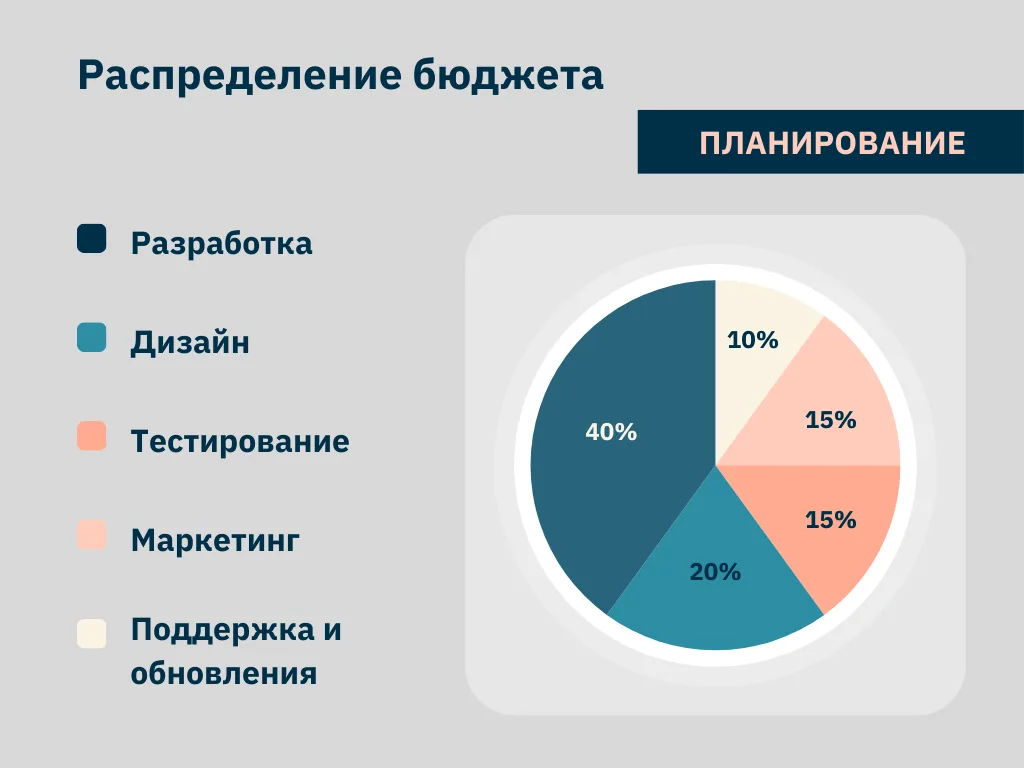
After conducting market analysis, the next step is to create a detailed development plan. It includes:
- Setting SMART goals: Specific, measurable, achievable, relevant, and time-bound goals help guide the development process.
- Defining key features and capabilities: Prioritize features based on user needs and the app’s goals. Start with a minimum viable product (MVP) to test the market before adding more complex features.
- Budgeting and resource allocation: Determine the required financial investment, including costs for design, development, testing, and marketing. Also decide whether you will use an in-house team or outsource development.
A well-known IT expert, Steve Wozniak, co-founder of Apple Inc., once said: “A great product starts with a great idea, but success requires a well-thought-out plan”. This statement highlights the importance of detailed planning in app development.
3. Choosing the right technology stack
Choosing the right technology stack is critical to an app’s success. The choice depends on several factors:
- Platform (iOS, Android, or both): Decide whether you will build a native app (for one platform) or a cross-platform app (compatible with multiple platforms). Native apps often provide a better user experience but require more resources.
- Programming languages: Swift and Objective-C are popular for iOS apps, while Java and Kotlin are for Android. For cross-platform apps, React Native and Flutter are popular.
- Backend technology: Choose a reliable backend solution to manage app data, users, and services. Node.js, Django, and Ruby on Rails are popular choices.
- Third-party service and API integrations: Determine which third-party services (for example, payment gateways, social logins) your app needs.

According to a Stack Overflow study, JavaScript, HTML/CSS, and SQL are among the most frequently used programming languages in 2023. Understanding the technology landscape helps you make informed decisions during the development process.
4. Designing an intuitive user interface (UI) and user experience (UX)
The design stage is when the app’s visuals and user experience come to life. A well-designed app is not only visually appealing but also easy to navigate. Key points to consider:
- User-centered design: Focus on the end user. Use personas and user journey maps to create an intuitive flow.
- Wireframing and prototyping: Create wireframes to define the app layout and prototypes to test with users and gather feedback.
- UI/UX principles: Follow established UI/UX principles such as simplicity, consistency, and accessibility. Use attractive visuals and animations in moderation.
According to an Adobe report, 38% of users stop engaging with a website or app if its content or layout is unattractive. That’s why investing in quality design matters not only for aesthetics but also for user retention.
5. Development stage: frontend and backend
The development stage involves turning designs into a functional app. This stage can be divided into two main parts:
- Frontend development: Focuses on the client side of the app, ensuring a seamless and responsive user interface. This includes coding in languages such as Swift, Kotlin, or JavaScript, depending on the platform.
- Backend development: Building the server-side logic, which includes databases, servers, and application programming interfaces (API). The backend is responsible for data storage, business logic, and security.
Use Agile methodologies such as Scrum or Kanban to manage the development process efficiently. Agile supports iterative development, allowing teams to adapt to changes and deliver incremental updates.
6. Testing and quality assurance (QA)
Testing is a critical phase that ensures the app’s quality and functionality. The testing process should cover:
- Unit testing: Testing individual components for functionality.
- Integration testing: Make sure different components work together without failures.
- User acceptance testing (UAT): Running tests with real users to gather feedback and identify issues.
- Performance testing: Testing the app’s performance under different conditions, such as high load or a poor connection.
- Security testing: Make sure the app is protected from potential threats.
According to an IBM report, the cost of fixing a bug found after product release is 4-5 times higher than a bug found at the design stage, and 100 times higher than at the maintenance stage. That’s why thorough testing is critical.
7. Launch preparation: marketing and deployment
When the app is ready, the next step is planning its launch. A successful launch strategy includes:
- Pre-launch marketing: Creating buzz through social media, press releases, and email newsletters.
- App Store Optimization (ASO): Optimizing the app store listing using relevant keywords, compelling descriptions, and high-quality visuals.
- Beta testing: Releasing a beta version to a limited audience to collect feedback and make final adjustments.
- Launch: Deploying the app to the selected platforms. Make sure all required permissions and requirements are met.
Sensor Tower research found that 70% of mobile app downloads come from searches in app stores. That’s why optimizing your app store presence is vital for visibility and downloads.
8. Post-launch: monitoring and updates
The journey doesn’t end at launch. Continuous monitoring and updates are necessary to maintain user engagement and app performance. Key post-launch activities include:
- Performance monitoring: Use analytics tools to monitor user behavior, app crashes, and performance metrics.
- Feedback collection: Actively collect user feedback through reviews, surveys, and in-app feedback forms.

Source – WADLINE
- Regular updates: Release regular updates to fix bugs, improve features, and introduce new capabilities.
As Jeff Bezos, CEO of Amazon, said: “Your brand is what people say about you when you’re not in the room”. Regular updates and user engagement ensure a positive brand image.
9. Legal and regulatory considerations
In today’s regulatory environment, compliance with legal standards is a must. Topics include:
- Data privacy laws: Ensuring compliance with GDPR, CCPA, or other regional data privacy laws.
- Intellectual property rights: Protecting your app’s intellectual property by registering trademarks, copyrights, or patents.
- Terms and conditions: Developing detailed terms of use, a privacy policy, and user agreements.
Failure to comply with legal requirements can result in fines, lawsuits, or even removal of the app from app stores. According to a Ponemon Institute study, the average cost of a data breach in 2023 was $4.35 million, underscoring the importance of data security.
10. Future trends in mobile app development
The mobile app industry is constantly evolving, and new technologies and trends are shaping its future. Key trends to watch:
- Artificial intelligence (AI) and machine learning (ML): Apps are increasingly integrating AI/ML to deliver personalized user experiences.
- Augmented reality (AR) and virtual reality (VR): AR and VR technologies increase user engagement in gaming, retail, and educational apps.
- 5G technology: The rollout of 5G promises to revolutionize app performance by delivering higher speeds and better connectivity.
- Internet of Things (IoT): IoT integration expands the functionality of mobile apps, especially in the smart home and healthcare sectors.
Future trends in mobile app development
| Trend | Expected growth by 2025 | Benefits |
| AI/ML | 45% | Personalization, automation |
| AR/VR | 30% | Increased engagement |
| 5G | 60% | Faster speeds and improved connectivity |
According to Gartner forecasts, by 2025, 75% of all data created by enterprises will be generated and processed outside the traditional data center or cloud, which requires the use of edge computing in mobile app development.
***
Developing a successful mobile app is a complex task that requires a mix of strategic planning, technical expertise, and continuous innovation. By following the key steps and best practices described in this article, companies can successfully navigate the complexities of mobile app development and create products that resonate with users and achieve long-term success in a competitive market.
At Amiscon, we specialize in building innovative mobile solutions tailored to your business needs, using advanced technologies in artificial intelligence, machine learning, computer vision, and blockchain. Our capabilities go beyond development; we shape the future of IT products in HR Tech and Sport Tech, helping innovative startups become industry leaders. Partner with Amiscon to turn your mobile app idea into reality, using our advanced technology and expert development to ensure your success in an ever-changing digital landscape.